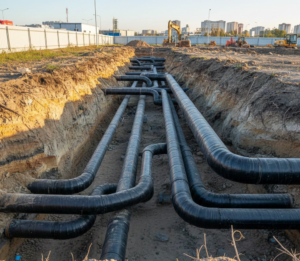
Butyl sealants and tapes are widely used in infrastructure construction, installation projects, and underground systems. Professionals use them to seal cable penetrations, pipe joints, foundations, and retention tanks. The key question is: how many years will a butyl seal last underground?
The answer depends on several technological and environmental factors. However, under optimal conditions, service life can range from 20–40 years, and in favorable environments, even longer.
Why Does Butyl Perform Well in Soil?
Butyl is a material with very low gas and water permeability. Unlike many reactive sealants (PU, MS polymers, silicone), butyl sealant:
-
does not fully harden,
-
remains permanently plastic,
-
compensates for substrate movement,
-
exhibits high resistance to anaerobic aging.
In underground environments, there is no UV radiation—one of the main factors degrading elastomeric materials. This is a significant advantage compared to above-ground applications.
Factors Affecting the Service Life of Butyl Underground
1. Type of Soil
Not all soils affect sealing materials in the same way.
Neutral soils (sand, clay with stable pH):
-
low chemical aggressiveness,
-
limited degradation risk,
-
potential durability: 30+ years.
Aggressive soils (peat, acidic soils, industrial areas):
-
presence of sulfates and hydrocarbons,
-
risk of gradual structural degradation,
-
reduced service life to 15–25 years.
Professionals implementing linear infrastructure projects (water and sewage networks, energy systems) should always review the geotechnical report before selecting a sealing system.
2. Constant Groundwater Pressure
Butyl performs very well in contact with water. However, constant hydrostatic pressure may lead to:
-
material migration,
-
slow plastic deformation,
-
the need for proper mechanical compression.
Practical example:
A cable penetration sealed in a foundation wall without a compression flange may deform after several years if groundwater levels are high.
In such cases, it is recommended to:
-
use compression systems,
-
limit the thickness of the applied layer,
-
combine butyl with a mechanical sealing barrier.
3. Soil Movement and Settlement
One of butyl’s greatest advantages is its permanent flexibility. Unlike rigid materials, it:
-
does not crack under micro-movements,
-
compensates for foundation settlement,
-
maintains tightness during pipeline movement.
However, in cases of significant displacement (e.g., mining-related ground movement), excessive stretching of the material may occur.
4. Application Quality
The service life of an underground seal depends heavily on correct installation.
Common installation errors:
-
application on wet or contaminated substrates,
-
insufficient compression,
-
layer too thin,
-
discontinuity of the joint.
In practice, poorly executed sealing may lose tightness after 5–10 years—even though the material itself could have lasted much longer.
Estimated Durability – Practical Data
Based on infrastructure projects and industry experience, the following estimates can be assumed:
| Working Conditions | Estimated Service Life |
|---|---|
| Dry, neutral soil | 30–40 years |
| Constant moisture, moderate pressure | 20–30 years |
| Chemically aggressive soil | 15–25 years |
| Strong ground movement | Project-dependent |
It is worth emphasizing that in an anaerobic environment, butyl ages more slowly than under atmospheric exposure.
Butyl vs. Alternative Underground Systems
In underground applications, butyl competes with:
-
polyurethane sealants,
-
bentonite systems,
-
injection resins.
Its advantages include:
-
immediate watertightness,
-
no shrinkage,
-
no chemical curing process dependent on moisture.
However, under very high hydrostatic pressure, hybrid solutions (butyl + mechanical protection) are often recommended.
How to Extend the Service Life of a Butyl Seal
For professionals, the following measures are crucial:
1. Selecting the Right Product
Not every butyl sealant is designed for underground use. Choose products with:
-
high chemical resistance,
-
stability across a wide temperature range,
-
verified aging test results.
2. Controlling Application Conditions
-
clean and degreased substrate,
-
no standing water,
-
appropriate application temperature.
3. Mechanical Protection
In areas exposed to damage, it is advisable to:
-
use protective covers,
-
shield the seal from direct contact with sharp aggregates.
Summary: How Long Will Butyl Last Underground?
A professionally installed butyl seal in favorable soil conditions can maintain watertightness for 20–40 years, and in some cases even longer. The key factors are:
-
geotechnical conditions,
-
groundwater levels,
-
correct application,
-
mechanical protection.
For infrastructure investors and contractors, this means that butyl is a durable and predictable solution—provided it is properly designed and installed according to best practices.