Introduction
In many applications of polymer materials, the success of the technological process is determined by the first phase of contact between the material and a surface. This applies, among others, to pressure-sensitive tapes, sealing compounds, protective films, and butyl materials used in the construction and automotive industries. In such cases, a key role is played by a property known as tack.
Although the phenomenon of tack is commonly observed in the everyday use of pressure-sensitive materials, its description and measurement under laboratory conditions are not trivial. This is particularly true for materials with a strong viscoelastic character, such as butyl compositions, for which classical testing methods do not always fully reflect the actual behavior of the material during application.
The aim of this article is to present the significance of tack in the context of polymer materials, discuss the methods used for its evaluation, and present a research approach developed specifically for butyl materials.
The Nature of Tack in Polymer Materials
Tack is defined as the ability of a polymer material to immediately adhere to another surface under light pressure and short contact time. This property refers only to the initial stage of the formation of an adhesive bond, not to its long-term strength.
Unlike parameters such as peel strength or shear strength, tack describes the initiation of adhesion, i.e., the moment when the material first comes into contact with the substrate and forms a real contact surface.
This phenomenon is directly related to the viscoelastic properties of the material. To exhibit appropriate tack, a polymer must satisfy two fundamental conditions:
- be sufficiently soft and deformable to quickly conform to the microscopic roughness of the surface,
- maintain adequate internal cohesion, preventing the material from tearing during separation.
The optimal balance between these properties is one of the key aspects in the design of adhesive material formulations.
The Importance of Tack in Butyl Materials
Butyl materials belong to a group of polymers with a clearly pronounced viscoelastic character. Their properties result from the structure of macromolecules as well as from the formulation components used, such as plasticizers, resins, and mineral fillers.
In industrial practice, the tack of butyl compositions affects, among others:
- the ability of the material to initially adhere to surfaces,
- stability of components during assembly,
- ease of application in automated processes,
- the behavior of the material during forming and pressing.
Too low tack may lead to problems with the initiation of adhesion, while excessive tack may hinder material processing, transport, or precise application.
For this reason, reliable evaluation of this parameter is an important element both in research and development activities and in quality control of butyl materials.
Classical Methods of Tack Measurement
Several standardized methods are used in laboratory practice to evaluate the tack of polymer materials.
Probe Tack Test
One of the most commonly used methods is the probe tack test. In this test, a steel probe with a defined geometry is pressed against the surface of the sample with a specified force for a set time. The probe is then withdrawn, and the apparatus records the maximum force and the energy of detachment.
This method provides high repeatability and allows precise control of experimental parameters. However, it takes place in a simplified contact system — between an ideally smooth probe surface and the material sample.
Loop Tack Test
In the loop tack test, a sample of pressure-sensitive tape is formed into a loop that briefly contacts the substrate. After contact, the tape is pulled away and the device records the maximum detachment force.
This method better reflects the real application conditions of pressure-sensitive tapes. However, the result may be sensitive to factors such as:
- the stiffness of the tape backing,
- the method of sample preparation,
- the actual contact surface.
Rolling Ball Tack Test
In the rolling ball method, a steel ball rolls down an inclined plane and stops on the surface of the tested material. The measure of tack is the distance traveled by the ball before stopping.
This test is quick and simple to perform. However, the result mainly depends on the kinetic energy of the ball and friction conditions, which limits its ability to differentiate materials with similar properties.
Limitations of Classical Methods for Viscoelastic Materials
Although the described methods form the basis of tack evaluation in many laboratories, their application to materials with a strong viscoelastic character may be limited.
In real industrial applications, contact between the material and the surface:
- is often very short,
- occurs on surfaces with different roughness and surface energy,
- is dynamic in nature.
Under such conditions, the initiation of adhesion may occur differently than in a model measurement system. As a result, parameters obtained in classical mechanical tests do not always fully correlate with the material behavior during real application.
Development of a Reference Tack Scale
In response to these limitations, a tack evaluation method based on a reference scale of butyl materials was developed.
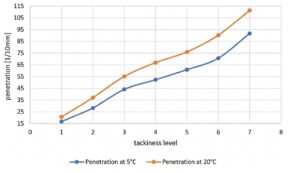
The basis of the method is a set of seven reference materials with intentionally differentiated tack levels. These materials form an ordered scale — from the sample with the lowest tack to the sample with the highest tack.
Each reference material was prepared under controlled technological conditions and subjected to additional physicomechanical characterization.
To verify the consistency of the scale, cone penetration tests were performed at 5°C and 20°C. The obtained results showed a linear relationship between penetration value and tack level.
This means that an increase in tack is associated with greater susceptibility of the material to deformation, which confirms the physical basis of the developed scale.
Standardization of Sample Preparation
To ensure repeatability of results, both reference samples and test samples are prepared in the same way.
The material is pressed to a thickness of 1 mm and then cut into 5 × 5 cm squares. The prepared samples are mounted on non-siliconized PET film, which prevents movement during testing.
This approach eliminates the influence of variables such as material layer thickness or substrate stiffness.
Tack Evaluation Procedure
The test consists of brief, repeatable contact of the tested material with the surface of the fingers, followed by comparison of the perceived tack with the reference samples.
The evaluation is performed by three independent observers, whose task is to indicate the scale level that best corresponds to the tested material or a range between two reference levels.
This approach allows for obtaining a repeatable classification of tack, which can be directly used in research and development processes as well as in technical communication.
Significance of the Method in Technological Practice
The developed method is not an alternative to classical mechanical tests, but rather a complement to them. Its main purpose is to capture a parameter that is crucial in many industrial applications — the immediate response of a material to very short surface contact.
The use of a reference tack scale makes it possible to:
- quickly compare different butyl material formulations,
- better match material properties to application process requirements,
- improve technical communication between the R&D department and the material recipient.
Summary
Tack is one of the key functional parameters of polymer materials used in adhesive applications. In the case of butyl materials, its importance is particularly high due to their strongly developed viscoelastic character.
Classical measurement methods provide valuable information about the mechanical parameters of the detachment process, but they do not always fully assess material behavior during the initial contact phase.
The introduction of a reference tack scale, based on standardized material samples and verified by penetration testing, enables a more practical evaluation of this property and provides a useful tool in the design and optimization of butyl compounds.