


Can we predict how long a plastic material will retain its properties? Is it possible to assess how effectively a material will resist ageing processes before it enters decades of service? The answer is yes. One of the most effective tools we use at Almara for this purpose is the OIT (Oxidation Induction Time) test. This method allows us to evaluate material durability at the laboratory stage—long before the product is subjected to the test of time.
Although the name may sound complex, the principle behind the test is relatively straightforward. Plastics, like many other materials, undergo oxidation over time. In practice, this means a gradual degradation of the material’s structure, which can lead to a decline in mechanical properties, changes in appearance, and a shortened service life. This applies to materials we encounter every day: water and gas pipes designed to remain underground for decades, packaging films, structural components, and automotive parts. To prevent this, special stabilizing additives—antioxidants—are incorporated into materials. OIT testing makes it possible to assess how effectively these additives protect the material against ageing. The rule is simple: the higher the OIT value, the greater the material’s resistance to degradation.
The measurement is performed using a Differential Scanning Calorimeter (DSC). A small material sample is placed in a crucible—aluminum, ceramic, or copper, depending on the type of material being analyzed—and heated to a specified temperature in an inert gas atmosphere, most commonly nitrogen. The nitrogen is then replaced with oxygen, and the measurement begins. The OIT value is determined as the time required for the material to start reacting with oxygen, i.e., to begin oxidizing.
The OIT method is primarily used for testing polymeric materials such as:
- Polyethylene (PE)
- Polypropylene (PP)
- Various polymer composites
The analysis can be performed on pellets, powders, raw materials, finished products, semi-finished products, or samples taken from components that have been in service for many years. As a result, OIT testing is widely used in research and development, quality control, and failure analysis.
For manufacturers and end users, OIT results provide valuable information about material quality and the effectiveness of the stabilizer package used. They enable comparisons between different formulations, monitoring of changes occurring during processing, and evaluation of the effects of ageing on product performance. In other words, OIT testing allows us to predict the future of a material. This enables manufacturers to make informed decisions regarding composition, quality, and durability before products are exposed to long-term service conditions.
At Almara, such testing forms one of the foundations of our research and development activities. We do not limit ourselves to quality control of finished products; we actively seek new solutions, analyze material behavior, and verify the effectiveness of various concepts already at the laboratory stage. The combination of specialized expertise, the experience of our R&D team, and advanced analytical equipment enables us not only to control product quality but also to develop and improve solutions that meet the growing demands of the market. Thanks to these studies, we make decisions based on data rather than assumptions.
1 + 1 Does Not Always Equal 2 – The Power of Antioxidant Synergy
One of the projects recently carried out by the Almara R&D team focused on evaluating the effectiveness of different antioxidant systems using OIT testing. The objective was not only to compare the performance of individual additives but also to determine whether carefully selected combinations could provide more effective protection against oxidation.
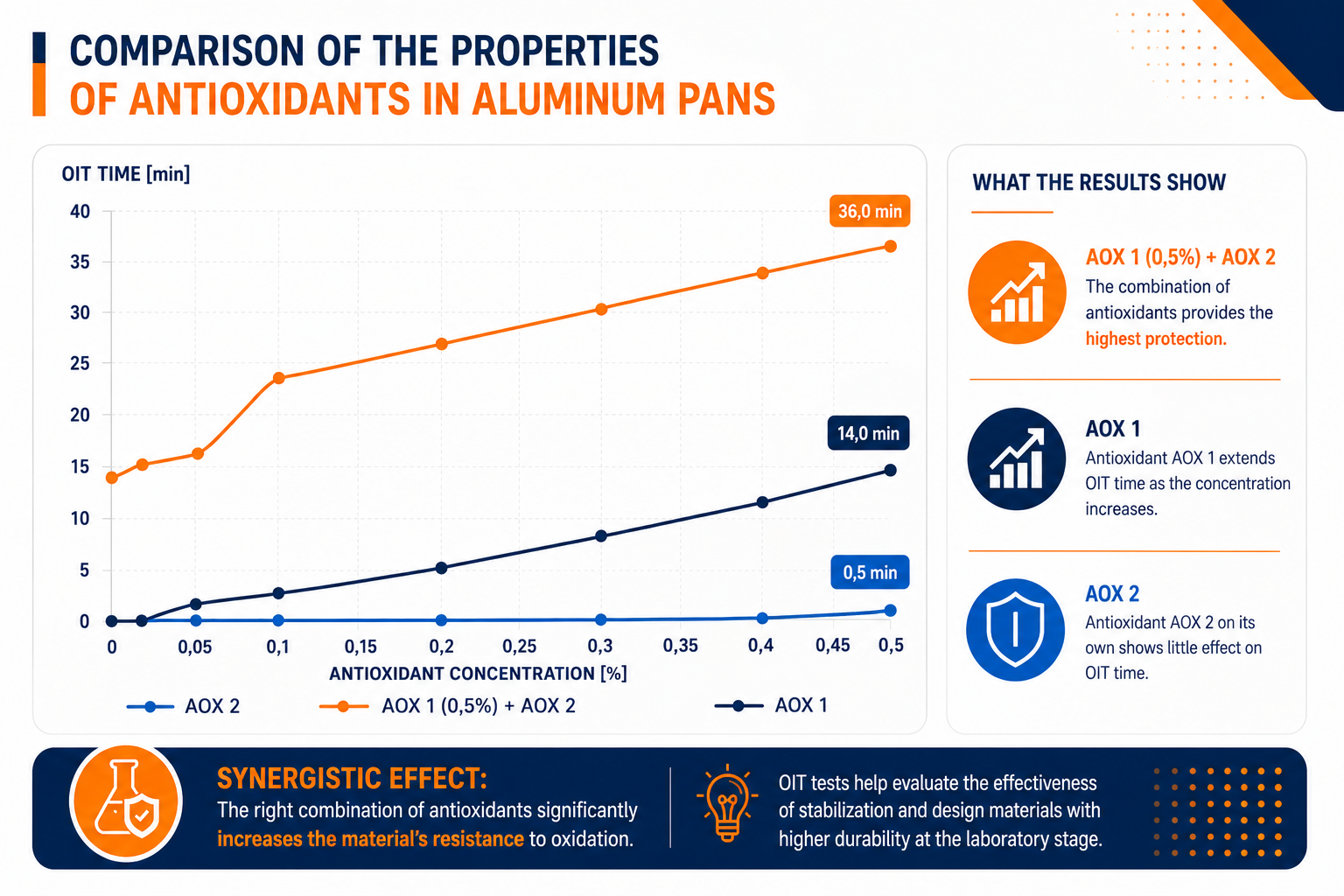
In the first stage, individual antioxidants were tested separately. The results showed that one of them (AOX 1) significantly increased the oxidation induction time as its concentration in the material increased, demonstrating its high effectiveness in protecting the polymer against degradation.
A second antioxidant (AOX 2), when evaluated on its own, did not produce as pronounced an increase in OIT values. At first glance, this might suggest that its contribution to material stabilization is limited. However, the analysis of multi-component systems revealed its true role, demonstrating that a seemingly minor effect of a single component does not necessarily mean it plays a minor role within the overall stabilization system.
The most interesting results were obtained for a formulation containing both antioxidants, while maintaining a constant AOX 1 concentration of 0.5%. In this case, the oxidation induction time was significantly higher than that achieved by either antioxidant used individually. This indicates that the additives did not act independently. On the contrary, they supported each other’s protective mechanisms, creating a system that was more effective than would be expected from the performance of either component alone.
This phenomenon is known as a synergistic effect. A useful analogy can be found in the relationship between vitamin C and iron in the human body—vitamin C does not supply iron itself, but it significantly enhances iron absorption. Similarly, the second antioxidant, although showing limited effectiveness when used alone, was able to substantially enhance the effectiveness of the first. In practice, this means that a carefully designed combination of additives can provide much stronger protection than the use of several additives separately, especially when one of them does not show remarkable performance on its own.
The results of this study further confirmed that in science and materials engineering, the most interesting answers are often found not in individual components but in the interactions between them. Discovering such relationships lies at the heart of the research and development work carried out at Almara. By utilizing advanced analytical techniques, we can not only evaluate material durability but also design solutions that better address the challenges of modern industry.
And this is only the beginning. OIT research at Almara continues on an ongoing basis—we are investigating new stabilizer systems, testing innovative combinations, and evaluating how different processing conditions influence material durability. We will continue to share the results of our work as they become available.