


The Role of Barite in Sealants
Barite is a filler with a density of 4.5 g/cm³ — almost twice as high as the raw materials typically used for this purpose. It is added to butyl sealant formulations specifically to increase the weight of the finished product. In this article, we explain what barite is, demonstrate through laboratory test results how it affects the properties of butyl sealant, and discuss where this type of material can be used.
Butyl Rubber: The Base No One Has Replaced Yet
Butyl sealants are primarily made from butyl rubber, which is what ultimately determines their applications. Gases permeate through it several dozen times more slowly than through natural rubber, which is why it has been used for decades as a sealant in insulating glass units, helping to retain the insulating gas between the glass panes.
In sealants, butyl rubber is not vulcanized, allowing it to remain soft and ductile for years. As a result, the sealant can deform together with the structure instead of cracking as the structure undergoes thermal movement. Butyl rubber is also resistant to water, frost, and ozone, as confirmed by decades of use in outdoor applications. No other rubber has so far succeeded in combining all these properties at once. This is why butyl rubber continues to be used in sealants for the construction, automotive, and industrial sectors.
Butyl rubber itself provides the sealant with tightness and flexibility, but creating a product with a broad range of useful properties requires combining it with other raw materials. Together, these components affect hardness, tack, density, and the ability to retain shape. For this reason, butyl sealant formulations are selected individually for each application so that the finished material meets specific requirements. However, no raw material affects only one property — changing one characteristic therefore means selecting an additive that will have the strongest possible effect on that property while altering the other parameters as little as possible.
Sealant Weight: Where Does It Come From and How Can It Be Controlled?
The filler accounts for most of the volume of the mixture, so it has the greatest influence on the density of the finished sealant. Butyl rubber represents a smaller share of the volume and has a relatively low density, meaning that the weight of the finished sealing strip is determined primarily by the choice of filler.
With a density of 4.5 g/cm³, barite increases the weight of the sealant more effectively than any of the raw materials routinely used for this purpose. This is why it is selected when the goal is to produce a high-weight, high-density product.
What Is Barite?
Barite is a mineral with the chemical formula BaSO₄ (barium sulfate). Its name comes from the Greek word barys, meaning “heavy.” One litre of powdered barite weighs 4.5 kg — the same as four and a half litres of water. In nature, the mineral forms flat, tabular crystals with a vitreous luster. They can be colorless, white, yellow, brown, or gray. For use in sealants, barite is always supplied as a finely ground powder.
Barite crystals may be associated with hardness, but the mineral is actually relatively soft. It has a Mohs hardness of approximately 3–3.5, while hardened steel used for the screws and dies of mixers and extruders can reach a hardness of around 6. For comparison, quartz, the main component of sand, has a hardness of 7.
This difference is important not only in the laboratory but also during sealant processing. Hard, abrasive particles can act like sandpaper on the working surfaces of processing equipment, accelerating the wear of screws, dies, and other components that come into contact with the mixture. Thanks to its lower hardness and low abrasiveness, barite is a considerably gentler filler in this respect. It therefore makes it possible to increase the mineral phase content of the sealant without placing as much stress on processing equipment as harder fillers do.
Origin of Barite
Barite can form under a variety of geological conditions. Its deposits are associated, among other things, with hydrothermal processes, during which barium sulfate crystals precipitate from hot, mineral-rich solutions.
Barite can also form in marine environments, where its mineralization is associated with processes occurring within sediments, including the decomposition of organic matter and microbial activity. Another mechanism is the concentration of barite through weathering and the leaching of more soluble components of rocks.
Different formation conditions translate into differences in the properties of the raw material. Barite from different deposits may vary primarily in purity, color, particle size, and particle shape. However, not all of these differences are relevant to sealants.
For this application, the most important factors are the purity and color of the raw material. Purity determines the content of impurities that may affect the properties of the finished formulation, while color determines the shade of the sealant itself. From the perspective of formulation, the remaining characteristics of the deposit are of secondary importance.
Where Is Barite Used?
Although sealants account for only a small proportion of barite applications, its properties make this mineral useful across many different industries.
The largest consumer of barite is the oil and gas industry. In drilling, it is used as a component of drilling fluids, where its high density increases the weight of the fluid. This allows the column of fluid in the wellbore to counteract formation pressure more effectively and reduce the risk of uncontrolled fluid influx from the reservoir.
Barite is also a raw material for the chemical industry, where it is used to produce various barium compounds, including barium carbonate. It is also used as a filler in the rubber, paper, and paint industries, where it can affect, among other things, opacity, density, and the chemical resistance of finished materials.
Because of its high density and good radiation-absorption properties, barite is also used in radiation protection. It is used, among other applications, in materials for shielding rooms where X-ray examinations are performed. Barium compounds, in turn, are used in diagnostic imaging.
The same properties — primarily high density, chemical stability, and relatively low hardness — also make barite an interesting filler for sealants, including butyl rubber-based sealants.
Barite in Butyl Sealant — Laboratory Test Results
In our R&D laboratory, we prepared a series of butyl rubber compounds with gradually increasing amounts of barite, from small additions to the complete replacement of the standard filler.
To assess the effect of barite on material properties, each mixture was compared with a corresponding reference sample with an identical base formulation containing a typical filler. We then tested the key performance properties of the resulting sealants: density, cone penetration, and 180° peel strength.
This made it possible to assess not only how the weight of the mixture changes as the barite content increases, but also whether changing the filler affects its consistency and adhesion.
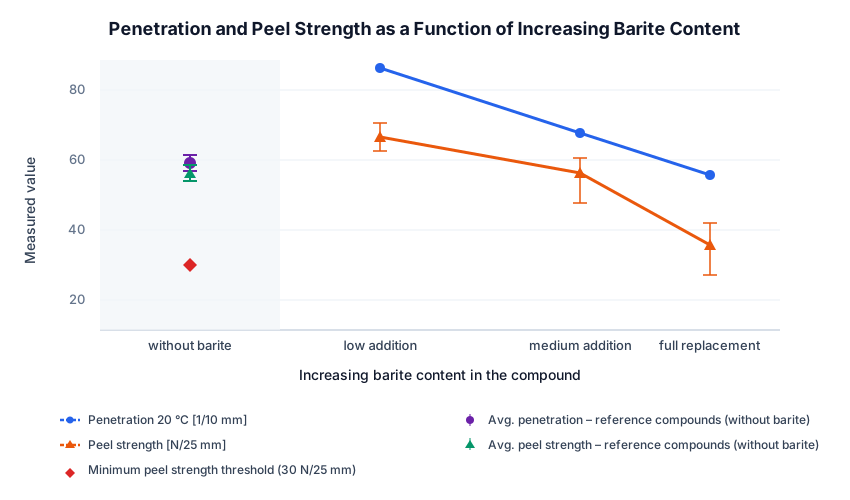
The results are presented in Charts 1 and 2.
Across the entire series tested, sample density increased as the barite content increased, as expected based on its high specific density.
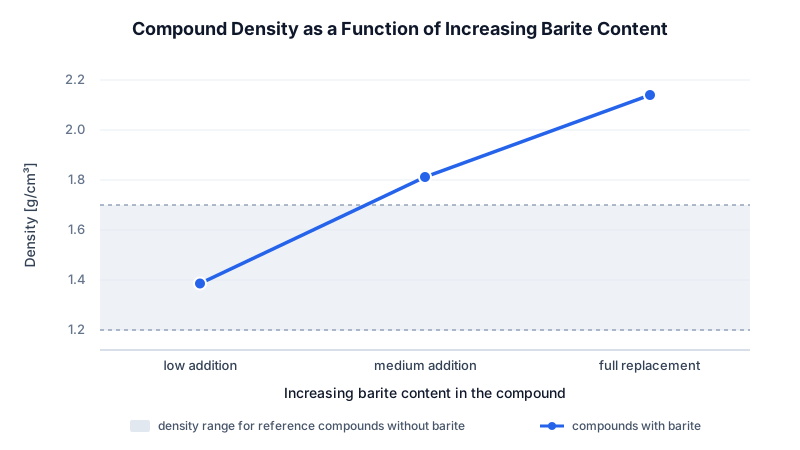
The use of barite in the tested sealants makes it possible to increase density to 2.13 g/cm³, which is difficult to achieve using conventional fillers.
Importantly, even when the standard filler was completely replaced with barite, changes in the material’s performance properties were small. The sealant maintained a comparable consistency, as confirmed by similar penetration values.
This parameter is directly related to the tackiness of the mixture, so it can be concluded that this property also remained at a similar level. Adhesion to the substrate remained within the typical range for butyl sealants, i.e. above 25–30 N/25 mm, similarly to the reference mixtures.
The most noticeable difference, however, concerned the weight of the finished sealant. With identical dimensions, a strip made from the mixture fully filled with barite weighed approximately 40% more than the corresponding element made from the reference mixture.
This means that barite makes it possible to significantly increase material density without a proportional deterioration in its basic performance properties.
Such a significant increase in weight opens the way to applications in which heavy tapes, including lead tapes, have traditionally been used. An aluminum roof flashing collar or ridge tape equipped with a layer of barite-containing sealant gains additional weight, allowing it to conform better to a profiled roof covering under its own weight and making it easier to maintain the desired shape.
Importantly, this effect can be achieved without using lead and without increasing the thickness of the sealing layer itself. Barite therefore makes it possible to use its high density not merely as a material parameter, but as a specific functional feature of the finished product.
When Greater Weight Becomes an Advantage
One of the key advantages of increasing surface weight is the potential to use barite in applications related to vibration damping and noise reduction. A thin sheet of metal can behave like a membrane when exposed to vibration — the lower its mass per unit area, the easier it is to set it in motion.
Applying a layer of barite-containing sealant to an equipment housing, ventilation duct, vehicle body panel, or roofing element increases the mass of the structure, reducing its susceptibility to vibration. As a result, both the element’s own vibrations and the transmission of the noise they generate can be reduced. This also applies to so-called impact sounds, such as the sound of rain hitting a metal roof.
In these applications, mass per unit area is a key parameter. Barite’s high density makes it possible to achieve the desired surface mass using a relatively thin layer of material, which can be a significant advantage in structures where available space is limited.
The same mechanism can be used in ballast compounds and acoustic barriers. In walls, doors, or machine enclosures, surface-mass requirements for a partition may be specified directly in the technical specification. The higher the material density, the thinner the layer can be while still achieving the required surface mass.
In the case analyzed, the use of barite makes it possible to achieve the same mass with a layer more than 40% thinner than one made with a standard filler.
Another potential application is radiation shielding. The effectiveness of a material in absorbing X-rays depends, among other factors, on its composition and thickness. The presence of elements with a high atomic number can increase its ability to attenuate radiation. With an atomic number of 56, barium is particularly interesting in this respect.
Butyl sealant containing barite can be used to seal joints, connections, and service penetrations in structures requiring radiation protection, reducing the risk of local discontinuities in the shielding.
All these applications share one characteristic: mass ceases to be merely a material parameter and becomes a functional property. Barite makes it possible to shift the properties of butyl sealant toward high density and high surface mass — precisely where additional weight can provide a tangible functional benefit.
At Almar, we believe that innovation begins where the obvious applications of a raw material end. That is why, in our R&D laboratory, we do more than test materials — we look for ways to turn their properties into practical solutions and design products that address specific industrial needs.
Because sometimes, “heavier” really can mean “better.”