


How Butyl Rubber Became One of the World’s Most Versatile Sealing Materials
Most people encounter butyl rubber every day without ever realizing it. Although its name is primarily known within the polymer and sealing industries, modern life would look very different without its unique properties. Thanks to this exceptional material, air remains inside tires and inner tubes for extended periods, medicines and vaccines are safely stored in airtight pharmaceutical vials, and modern insulated windows protect buildings from heat loss and moisture.
Today, butyl rubber is one of the most important materials used in sealing technology. Its applications span numerous industries, including automotive manufacturing, energy-efficient construction, pharmaceuticals, infrastructure, and advanced industrial engineering.
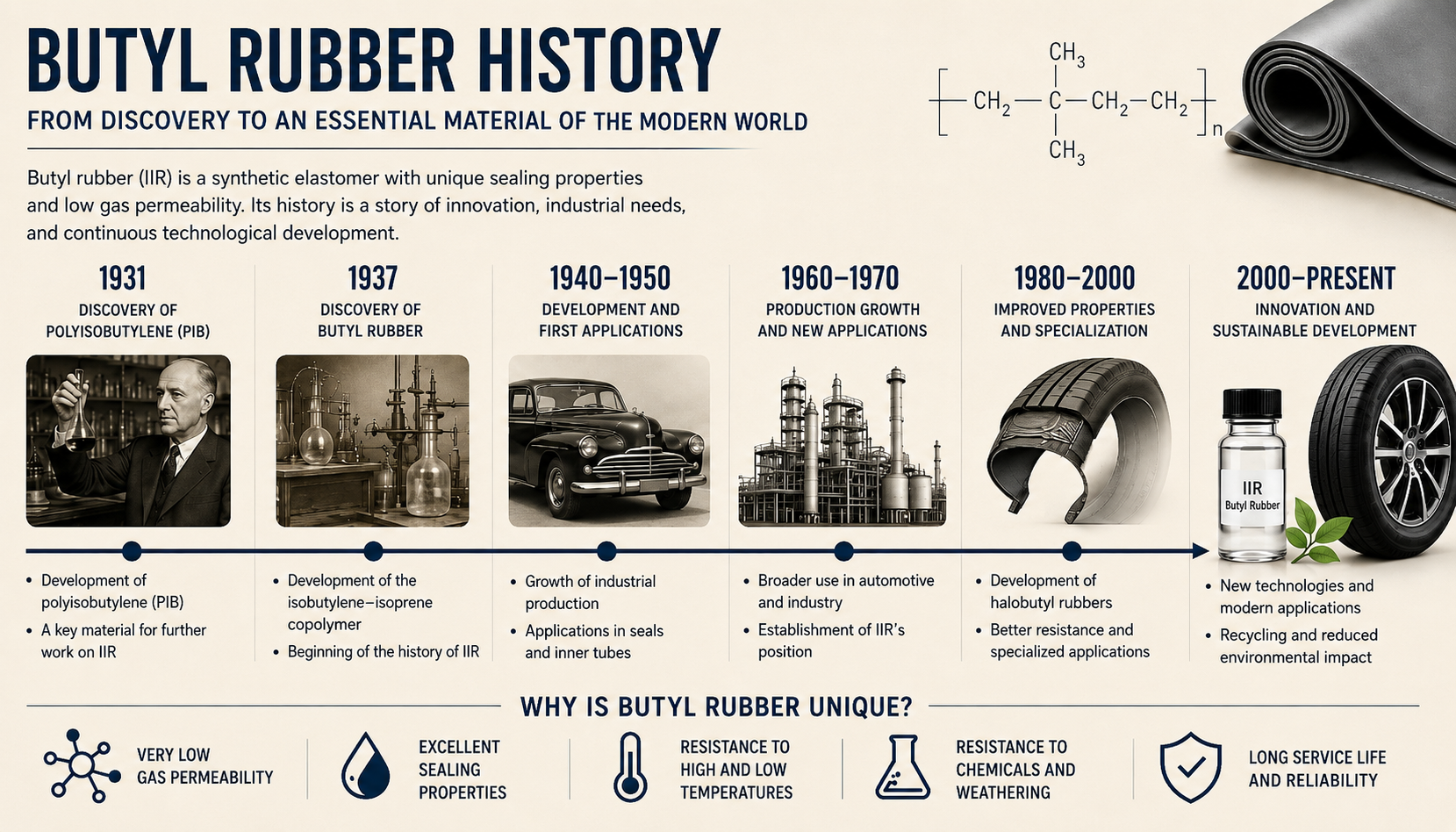
For more than 80 years, butyl rubber (IIR) has been the material of choice wherever airtightness, durability, and long-term reliability are essential. Its development mirrors the evolution of modern polymer science—from groundbreaking research conducted in the 1930s and 1940s to today’s sophisticated technologies used across construction, transportation, medicine, renewable energy, and even defense industries.
In recent years, sustainability has become another driving force behind the evolution of butyl-based materials. Increasing environmental regulations, stricter limits on volatile organic compound (VOC) emissions, growing demand for energy-efficient buildings, and the need for recyclable materials have encouraged manufacturers to develop solvent-free butyl sealants and environmentally responsible sealing solutions.
How did a single polymer become indispensable across thousands of applications and help shape modern industry? The answer begins nearly a century ago.
The Origins of Butyl Rubber: From Polyisobutylene to a Revolutionary Elastomer
The history of butyl rubber began long before it was used in tires or modern sealing systems. Its roots date back to the early 1930s—a period marked by rapid advances in polymer chemistry, when scientists around the world were searching for synthetic materials capable of replacing natural resources and meeting the growing demands of industrial production.
One of the first breakthroughs came in 1931 with the development of polyisobutylene (PIB), a polymer produced from isobutylene. Researchers quickly recognized its unique combination of properties, including:
- outstanding chemical resistance,
- excellent flexibility,
- exceptionally low gas permeability,
- superior resistance to moisture and water vapor.
These characteristics made polyisobutylene an ideal material for applications where long-lasting airtightness and environmental resistance were critical.
The real breakthrough arrived in 1937, when William Sparks William Sparks and Robert Thomas Robert Thomas developed butyl rubber (IIR – Isobutylene Isoprene Rubber). Unlike pure polyisobutylene, this new copolymer consisted primarily of isobutylene with a small amount of isoprene.
Although the isoprene content represented only a small fraction of the polymer, it introduced a critical advantage: it allowed the material to be vulcanized. This made it possible to manufacture durable rubber products with mechanical properties that were previously unattainable for most elastomers.
Industrial production of butyl rubber began in the early 1940s, coinciding with World War II. At the time, access to natural rubber from Southeast Asia became severely restricted, accelerating the development of synthetic alternatives. As a result, butyl rubber quickly gained strategic importance across numerous industries.
Its most valuable characteristic was its exceptionally low permeability to gases. This made it the preferred material for manufacturing inner tubes, including those used in military vehicles. By significantly reducing air loss, butyl rubber improved equipment reliability while minimizing the need for frequent tire inflation under demanding field conditions.
Polyisobutylene also found applications beyond conventional rubber products. Thanks to its ability to function as a durable, flexible binder, it became a component of certain plastic explosive formulations, including C-4. In these applications, PIB does not act as the explosive ingredient. Instead, it serves as a binder that provides the material with its characteristic plasticity, mechanical stability, and moldability, making it safer to handle and easier to shape.
The history of C-4 also gave rise to one of the military’s most famous urban legends. Because of its gum-like consistency, stories emerged claiming that soldiers occasionally chewed C-4 like chewing gum. Whether these accounts were widespread remains difficult to verify, but they contributed to the well-known safety warnings found on explosive materials today. Importantly, the toxicity was never associated with polyisobutylene itself. The hazardous component was RDX, the primary energetic ingredient in C-4, while PIB functioned solely as the inert polymer binder.
From Military Technology to Everyday Life
The end of World War II did not mark the end of butyl rubber’s development—quite the opposite. It became the starting point for its widespread adoption across civilian industries. The same properties that had once been considered strategically important—exceptional airtightness, chemical resistance, and long-term durability—proved equally valuable in manufacturing, transportation, and everyday life.
One of the first industries to embrace these advantages on a large scale was the automotive sector.
Keeping Air Where It Belongs: Butyl Rubber Revolutionizes the Automotive Industry
The rapid growth of transportation throughout the twentieth century created a demand for materials that were not only strong and flexible but also capable of retaining air inside tires for extended periods.
Before the introduction of butyl rubber, inner tubes made from conventional elastomers gradually lost pressure because gases could slowly diffuse through the rubber. Frequent reinflation was therefore a normal part of vehicle maintenance.
The introduction of butyl rubber dramatically reduced this problem. Thanks to its exceptionally low gas permeability, inner tubes retained air much longer, improving vehicle safety, reliability, and service life while reducing maintenance requirements.
This advantage proved invaluable not only in passenger vehicles but also in military and heavy-duty equipment operating under demanding conditions, where maintaining tire pressure was essential for operational reliability.
As tire technology evolved, butyl rubber also became the preferred material for the inner liner of tubeless tires. In modern tires, this thin butyl layer acts as an airtight barrier that minimizes air loss and allows the tire to maintain proper inflation over long periods.
Today, sustainability has become another important factor in tire manufacturing. Used butyl inner tubes and tires are increasingly recognized as valuable sources of recycled rubber. After appropriate processing, reclaimed butyl materials can be incorporated into new sealing compounds and rubber formulations, reducing landfill waste and supporting a more circular economy.
This approach—integrating recycled raw materials into high-performance sealing compounds—is also one of the development directions pursued by Almara, which continues to expand its portfolio of sustainable butyl technologies.
Long-Lasting Sealing Performance: Butyl Rubber in Construction
Following its success in the automotive industry, butyl rubber quickly established itself as one of the most reliable sealing materials used in construction. Its outstanding resistance to weathering, extremely low permeability to water and gases, and ability to remain flexible for decades made it an ideal choice for demanding building applications.
By the mid-twentieth century, polyisobutylene (PIB) was already being used in waterproofing membranes designed to protect roofs and building structures from moisture intrusion.
Unlike many traditional sealing materials, PIB- and butyl-based products not only created an effective barrier against water but also maintained long-term elasticity and permanent plasticity. This allowed buildings to accommodate thermal expansion, structural movement, and mechanical stress without compromising the integrity of the seal.
The exceptional longevity of butyl materials has made them a cornerstone of waterproofing technologies for decades. In practice, this means maintaining sealing performance over many years despite continuous exposure to UV radiation, moisture, temperature fluctuations, and harsh environmental conditions.
Today, however, the technology continues to evolve. While solvent-based butyl products remain in use, the industry is increasingly shifting toward solvent-free butyl sealants that comply with stricter environmental regulations and help reduce volatile organic compound (VOC) emissions.
This is also the direction taken by Almara, which develops solvent-free product lines in response to the evolving sustainability requirements of the global construction industry.
For manufacturers, this represents a significant technological challenge. Modern butyl sealing materials must simultaneously deliver exceptional airtightness, long-term durability, and environmental responsibility. Almara’s expertise in formulating advanced butyl compounds makes it possible to combine all three requirements within a single high-performance solution.
Hidden Technology: Butyl Rubber in Insulating Glass Units (IGUs)
Although most building occupants never see it, butyl rubber plays a vital role in one of the most important components of modern energy-efficient buildings—insulating glass units (IGUs). Thanks to advanced sealing materials, insulated glazing systems are able to maintain their thermal performance for decades.
Within an IGU, butyl rubber is primarily used as the primary sealant. Its function is to create an airtight and moisture-resistant barrier that prevents water vapor from entering the cavity while retaining insulating gases—most commonly argon—between the panes of glass.
Both functions are essential for preserving the thermal insulation performance of the glazing unit throughout its service life.
Depending on the window design, the primary butyl seal is complemented by a secondary sealant, which provides structural strength and long-term mechanical stability. Advances in glazing technology have also led to the development of systems such as Thermoplastic Spacer (TPS) technology, where thermoplastic spacer materials combine sealing and insulating properties into a single integrated solution.
Insulating glass units perfectly demonstrate the most valuable characteristic of butyl rubber—its exceptionally low gas permeability. By effectively sealing the space between the glass panes, butyl rubber helps retain insulating gases for many years, directly improving the window’s thermal efficiency and contributing to the overall energy performance of the building.
In modern construction, airtightness is no longer simply a matter of durability—it is a key factor in achieving lower energy consumption, improved indoor comfort, and compliance with increasingly demanding building performance standards.
Protecting More Than Materials: Butyl Rubber in the Pharmaceutical Industry
The pharmaceutical industry represents one of the most demanding applications for butyl rubber. In this field, a sealing material must offer much more than durability and airtightness. It must also satisfy rigorous requirements for chemical purity, stability, biocompatibility, and product safety.
For this reason, halobutyl rubbers—particularly bromobutyl rubber and chlorobutyl rubber—have become the industry standard for manufacturing pharmaceutical closures.
The familiar rubber stopper beneath the aluminum cap of a medicine vial serves as a critical barrier, protecting drugs from external contamination while allowing repeated needle punctures without compromising the seal.
These properties are especially important for vaccines, biologics, injectable medicines, and other pharmaceutical products that must be stored under tightly controlled conditions.
The material’s extremely low permeability to gases and moisture helps preserve product quality throughout its shelf life, while carefully engineered rubber formulations minimize the risk of unwanted interactions between the closure system and the drug itself.
What began as a search for a high-performance industrial elastomer has evolved into a material that now plays a crucial role in protecting medicines that directly affect human health and patient safety.
Beyond Industrial Applications: Polyisobutylene in Chewing Gum
One of the most surprising examples of the versatility of polyisobutylene (PIB) is its use in everyday consumer products.
The same polymer family that is widely used in advanced industrial sealing technologies can also be found in the gum base of certain chewing gums.
At first glance, the connection between a material used in industrial sealants and a food product may seem unexpected. In reality, it highlights the remarkable versatility of modern polymer science.
A polymer can serve completely different purposes depending on its formulation, purity, and regulatory compliance. When manufactured to meet stringent food-contact standards, polyisobutylene contributes to the elasticity, chewability, and durability of chewing gum while fully complying with food safety regulations.
This represents another fascinating stage in the evolution of polyisobutylene—from a polymer originally developed for industrial applications to an ingredient found in products used daily by millions of people around the world.
When Silence Matters: Butyl Rubber in Specialized Applications
Not all applications of butyl rubber are immediately visible. In many advanced engineering solutions, its greatest value lies not in its mechanical strength but in its ability to dampen vibrations, absorb energy, and reduce noise transmission.
These unique characteristics have made polyisobutylene (PIB) and butyl rubber essential materials for applications where vibration control and acoustic insulation are critical. One notable example is their use in marine engineering, where specialized soundproofing and anti-vibration systems help reduce the transmission of noise and mechanical vibrations.
In applications such as submarines, noise reduction is particularly important. Every component capable of limiting vibration transfer contributes to improved operational performance, enhanced crew comfort, and lower acoustic signatures.
Thanks to their molecular structure and outstanding damping properties, butyl-based elastomers are widely used in these demanding environments.
The same characteristics also benefit many other industries—from industrial machinery and heavy equipment to specialized protective systems used in infrastructure and transportation.
Like many high-performance materials, butyl rubber often works behind the scenes. Although invisible to the end user, its ability to absorb vibrations and minimize noise significantly improves the durability, reliability, and performance of countless modern technologies.
One Polymer, Thousands of Applications: Why Butyl Rubber Remains Essential
The history of butyl rubber demonstrates that the greatest value of a material often lies in its ability to remain relevant across generations of technological progress.
Nearly a century after its invention, butyl rubber continues to address some of today’s most important engineering challenges—including airtight sealing, long-term durability, energy efficiency, sustainability, and product safety.
From its early development during the pioneering era of polymer chemistry, through the industrial demands of World War II, to its current applications in automotive manufacturing, construction, pharmaceuticals, infrastructure, and countless other industries, butyl rubber has established itself as one of the world’s most versatile elastomers.
Its enduring success is built upon a unique combination of properties that few materials can match:
- exceptionally low gas permeability,
- excellent chemical resistance,
- outstanding weatherability,
- long-term flexibility,
- durable sealing performance,
- and reliable mechanical stability over decades of service.
These characteristics allow a single polymer to perform remarkably diverse functions—from keeping air inside tires and protecting life-saving medicines to ensuring the airtightness of energy-efficient buildings and advanced industrial systems.
Driving Innovation in Modern Butyl Technologies
This is where companies such as Almara play an increasingly important role.
By combining decades of expertise in butyl rubber technology with modern manufacturing capabilities, Almara develops advanced butyl compounds, butyl tapes, butyl cords, and customized sealing solutions tailored to the evolving needs of global industries.
Today’s customers expect much more than reliable sealing performance. They require products that improve manufacturing efficiency, support sustainable production, comply with increasingly strict environmental regulations, and deliver consistent quality throughout long service lives.
To meet these expectations, Almara continues to invest in solvent-free butyl technologies, environmentally responsible formulations, and innovative sealing systems that reduce environmental impact without compromising performance.
This commitment demonstrates that even a material approaching its hundredth anniversary can continue to evolve and meet the demands of the future.
Ultimately, the story of butyl rubber reminds us that true innovation does not always require inventing entirely new materials. Sometimes, it comes from unlocking the full potential of a proven polymer and continuously adapting it to solve the challenges of modern industry.