


What do a yacht hull, a wind turbine blade and a lightweight bicycle frame have in common? All can be made from composites formed beneath an airtight film, with the air drawn out from underneath. This is vacuum bagging. The pressure difference presses the layers of material against a mould, helping to produce a component with the required shape and properties.
Fibres, resin and a pump are only part of the process. A small strip of sealant also plays an essential role. It joins the film to the mould and helps maintain the vacuum throughout the cycle. Here we explain how the process works, where it is used and why butyl tape is such a common choice for sealing the bag.
Fibres and resin: two materials working together
A composite combines at least two constituents to achieve properties that would be difficult for either to provide on its own. In fibre-reinforced composites, the main constituents are the fibres and the resin that binds them.
Glass, carbon and aramid fibres are used in forms such as fabrics and mats. They provide much of the material’s strength, particularly in tension. Once cured, the resin – typically epoxy, polyester or vinyl ester – forms a matrix that holds the fibres in position and helps transfer loads between them.
A well-designed composite can combine low weight with high stiffness and strength. The result depends on the proportion of fibres and resin, the fibre arrangement and the quality of the bond between them. Excess resin can add weight without a corresponding increase in strength. Porosity – the presence of voids within the material – can weaken the structure.
Manufacturing quality also matters. The layers need to be evenly impregnated, with as little trapped air as possible. Simply combining fibres with resin does not guarantee a good result.
Impregnating fibres by hand with a brush and roller takes care. Wetting every layer evenly and removing trapped air can be difficult. Vacuum bagging helps consolidate the resulting laminate: a stack of reinforcing layers impregnated with resin. It does not replace proper material preparation or suitable processing conditions.
How does the pressure difference compact the laminate?
A hydraulic press can force material against a mould, but building one large enough to accommodate an entire yacht hull would be a considerable challenge. Vacuum bagging instead uses atmospheric pressure acting on the outside of an airtight film.
The laminate is covered with film, which is sealed around its perimeter. A pump draws air out of the bag, reducing the pressure inside while ambient pressure remains outside. The difference in pressure across the film provides the compaction force: the film presses on the laminate, which in turn presses against the mould. This allows pressure to be applied over a large area, including curved components.
At an atmospheric pressure of approximately 1,013 hPa, with almost all the air removed from the bag, the force on one square metre is equivalent to the weight of about 10 tonnes. For an A4 sheet, the equivalent weight is roughly 640 kg; for a 1 × 2 m panel, about 20 tonnes.
These are approximate values for a maximum pressure difference approaching one atmosphere. A perfect vacuum is not achieved in practice, so the actual compaction pressure is lower and depends on the vacuum attained. The examples illustrate the scale of the force; they do not specify the settings required for every process.
Compaction helps consolidate the laminate and reduce trapped air. With a suitable arrangement of consumables, excess resin can also be drawn off in a controlled way. The principle resembles vacuum food packaging: once the air is removed, the film fits closely around the contents. Composite manufacturing, however, places much greater demands on the materials, geometry and processing conditions.
Industrial bags may cover components many metres long. The film and seal must continue to perform throughout the specified cycle.
What goes beneath the bagging film?
A vacuum bagging assembly uses materials with different functions. Some become part of the finished component; others provide air paths, control resin flow or help separate the layers after curing. The choice of materials and their order depend on the process.
Many consumables are single-use and removed at the end of the cycle. They influence the manufacturing process without becoming part of the finished component.
- The mould gives the component its shape. It may be made from metal or composite or, in simpler applications, suitably prepared MDF. A release agent on the mould surface helps the finished component separate from it.
- The laminate is the product itself: layers of fibres combined with resin. Their composition and arrangement influence the finished component’s properties.
- Peel ply is placed next to the laminate and removed after curing, leaving a textured surface. Whether that surface can be bonded or receive further layers without additional preparation must be assessed for the particular material and operation.
- Release film separates the laminate from the consumables above it. Perforated film allows controlled resin bleed, while non-perforated film restricts it.
- Breather fabric provides air paths and helps distribute the vacuum beneath the bag. Depending on the material and configuration, it may also absorb excess resin.
- Bagging film covers the assembly and, once sealed, forms the vacuum bag. It must conform to the component’s shape and withstand the processing conditions.
- Sealant tape joins the film to the mould around its perimeter. A mouldable butyl compound is often used. An airtight seal makes it possible to maintain the required vacuum.
- Connections, hoses and the vacuum pump allow air to be drawn out. Their positions should allow air to be removed from across the assembly.
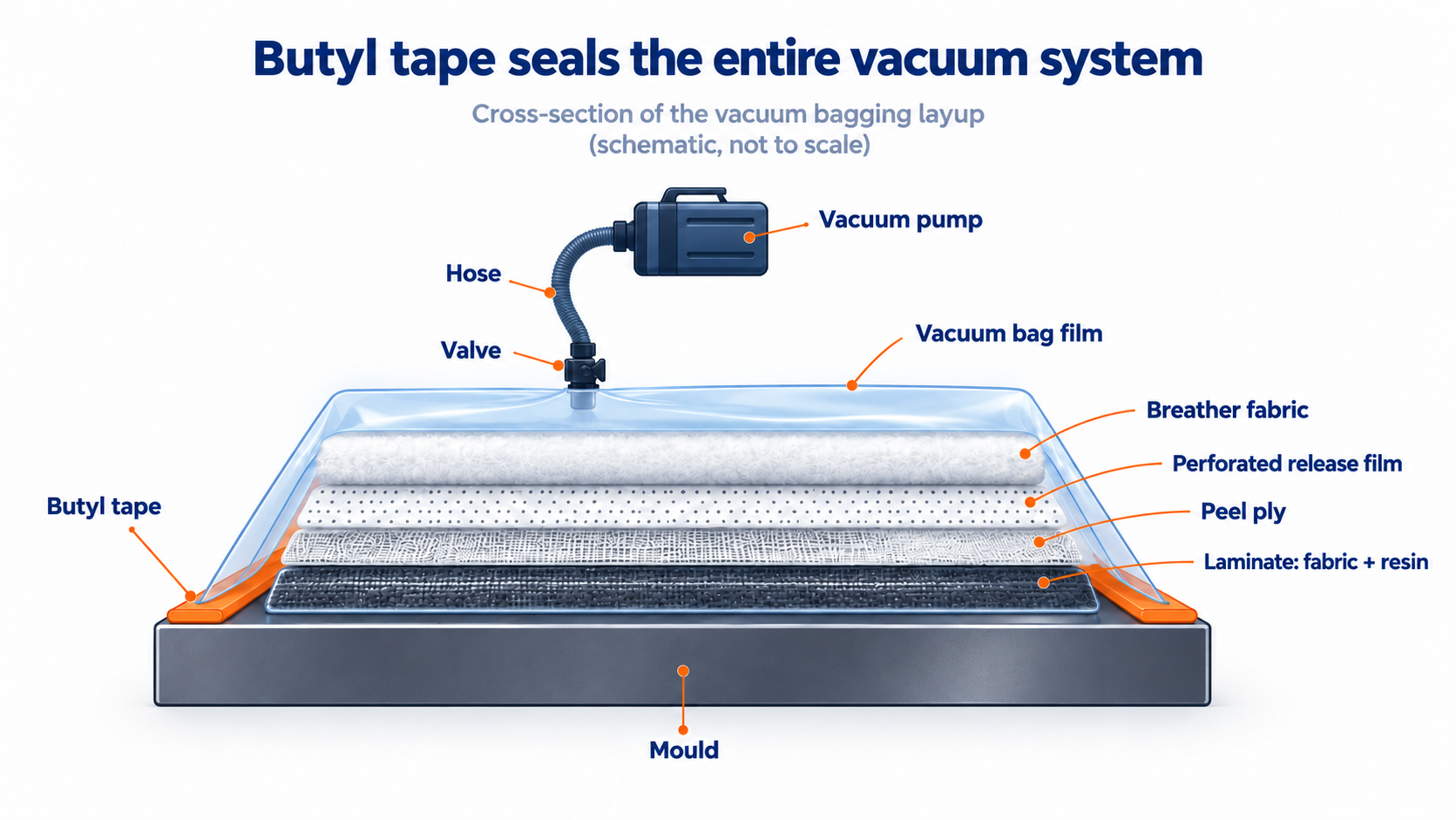
The tape around the mould perimeter separates the inside of the bag from the surrounding atmosphere. As the pump removes air, the film conforms to the assembly and presses its layers together. Correctly laid film, clear air paths and airtight connections therefore need to work together.
Depending on the resin and process, curing may take place at room temperature or at an elevated temperature. Some processes use an autoclave: a chamber that combines vacuum inside the bag with increased external pressure and a controlled temperature. The one-atmosphere limit for a bag operating in ambient air therefore does not describe the compaction pressure available in an autoclave.
Vacuum bagging and infusion: when is the resin introduced?
An airtight bag is used both to compact layers already impregnated with resin and in resin infusion. Both methods use a pressure difference, but the material is prepared differently.
Conventional vacuum bagging
The fibres are impregnated with resin before the bag is sealed, for example by hand. Alternatively, prepregs can be used: reinforcement materials pre-impregnated with resin under controlled factory conditions. Once the layers are in place, the assembly is covered with film, sealed and evacuated.
Prepregs often require curing at an elevated temperature and, for some applications, in an autoclave. These approaches are used in industries including aerospace and motorsport.
Vacuum infusion
In vacuum infusion, dry fibres and consumables are first laid on the mould. The assembly is then enclosed in a bag, a vacuum is applied and the resin inlet is opened. The pressure difference drives resin through the fibre stack.
A well-designed resin feed arrangement helps control the flow and reduce the risk of dry areas. Infusion is used for large components such as boat hulls and wind turbine blades.
Keeping the resin within the sealed assembly also helps limit spills beyond the laminating area. The positions of the resin inlet and air outlets are part of the process design, alongside the arrangement of the layers.
Leaks can disrupt either method. In vacuum bagging, they make it harder to maintain compaction pressure; in infusion, they also affect resin flow through the dry fibres.
From boats to sports equipment
Vacuum bagging is used where low weight, strength and the ability to produce complex shapes matter. The scale and processing conditions vary between industries.
- Boatbuilding: hulls, decks and superstructures are made using processes that include vacuum infusion. The technology allows large moulds to be used without placing them in an equally large press.
- Wind energy: large turbine blades require the bag to be sealed around a long mould perimeter. Careful preparation of the layers and an airtight seal throughout the cycle are essential.
- Aerospace: fuselage, wing and cabin components can be made from prepregs cured in autoclaves. Curing conditions are selected for the material and structural requirements.
- Automotive manufacturing and motorsport: body panels, spoilers, bonnets and interior components benefit from low weight and high stiffness. Carbon-fibre composites play a prominent role in this sector.
- Sports equipment: selected bicycle frames, surfboards, kayaks, paddles and other composite products. Their performance depends on the combination of materials, design and a properly controlled manufacturing process.
- Construction, industry and hobby workshops: selected panels, covers, small model structures and drone housings. Smaller components need simpler equipment, but still require an airtight bag and suitable working conditions.
Not every composite component is made this way. The choice depends on factors including geometry, required properties and production scale. From a small workshop to a large industrial installation, an airtight assembly remains a common requirement.
Why use butyl for the seal?
A small leak around the mould perimeter can make the required vacuum difficult to maintain. Compaction pressure may become insufficient, allowing voids to remain in the laminate. In infusion, incoming air can also disrupt resin flow. The finished component may then fail to meet quality requirements, with repair or rejection resulting in material and financial losses.
Butyl rubber is a copolymer of isobutylene and a small proportion of isoprene. Its very low gas permeability is valuable in sealing applications. Whether a finished tape is suitable, however, depends on its complete formulation, not just the type of polymer.
In vacuum bagging, the compound’s ability to conform and adhere is also important. Under pressure, it moulds around small surface irregularities, folds in the film and corners. It adheres to both surfaces without needing to dry or cure, allowing the seal to be formed during assembly.
The tape must retain the required properties throughout the cycle, including when the bag remains under vacuum for many hours or is heated. Not every butyl tape is therefore suitable for every process. Laminating at room temperature places different demands on the seal from a lengthy cure at an elevated temperature.
Selection needs to account for airtightness, adhesion, processing temperature and duration, and subsequent tape removal. Ease of removal and the amount of residue depend on the formulation, mould surface, contact with processing materials and the conditions during the cycle. Clean removal should not be treated as an unconditional property of every butyl compound.
For more on selecting and qualifying these materials, see our article on vacuum bag sealant tape in wind turbine blade manufacturing.
A large component starts with an airtight seal
Vacuum bagging uses a pressure difference to form composites without a large press acting on the whole component. Its effectiveness still depends on the materials working together, proper preparation of the assembly and suitable processing conditions.
Sealant tape is part of that process. At Almara, we formulate butyl compounds for specific applications, taking account of the required mouldability, adhesion and operating conditions. A suitably chosen material helps keep the bag airtight, providing the conditions needed for the subsequent stages of composite manufacture.